
What Lies Beneath New York City’s Sidewalks
Sidewalk vaults, the hidden extensions of buildings that run beneath the public sidewalk, date back to the 19th-century when coal deliveries, utilities, and storage demanded space in a fast-growing city with little room to spare.
They sit beneath the public right of way, but adjacent property owners are typically responsible for maintaining them. Because they are dark, concealed, and rarely visited, sidewalk vaults are often among the most neglected areas of a building, home to utility equipment, forgotten storage, and occasionally, New York City wildlife.
Here is the challenge: a sidewalk vault is both structure and roof. It carries constant pedestrian loading while enduring water infiltration, de-icing salts, and freeze and thaw cycles. Over time, moisture corrodes steel beams, weakens concrete, and quietly reduces structural capacity. Problems often go unnoticed until cracks, rust staining, spalling, or uneven pavement appear at the surface.
Left unaddressed, deterioration can become a public safety issue. In one case, we were called after someone nearly fell through a compromised sidewalk near a building entrance.
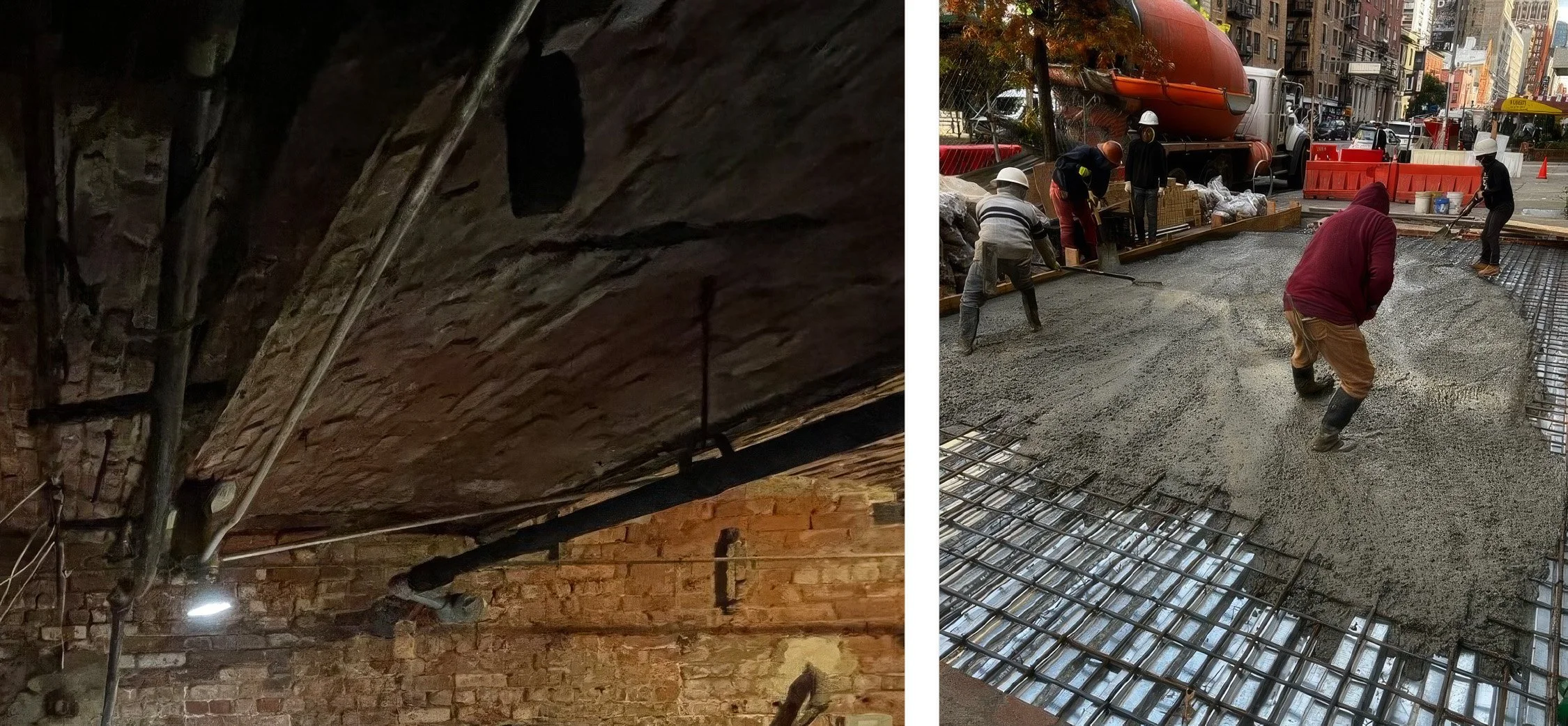
Left: A deteriorated sidewalk vault beneath ground. Right: Pouring a new reinforced structural slab above a repaired sidewalk vault.
Proper remediation begins with investigation and documentation, followed by filings with city agencies including the New York City Department of Buildings, the New York City Depart-ment of Transportation, and, when applicable, the New York City Landmarks Preservation Commission.
Construction typically involves shoring, removal of the sidewalk slab, repair or replacement of deteriorated steel, new decking and reinforcement, placement of a new structural slab, and most important, robust waterproofing to ensure long-term performance.
We are routinely called to investigate suspected vault conditions, prepare construction documents, coordinate filings, and guide projects through completion. It is not flashy work. But it protects pedestrians, preserves buildings, and strengthens long-term value.
Sometimes the most important work is the work no one sees.